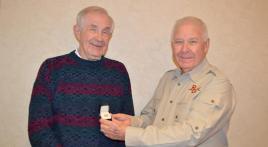
Does the world know the heroes who walk among us? There is a hero in Tariffville, Conn. A veteran of the post-WWII violence in Trieste, Italy, and a nuclear expert handpicked by the father of our nuclear Navy, Adm. Hyman G. Rickover. That man is Loering Johnson, drafted into the U.S. Army in 1945 from his family farm in Bellfield, N.D. He reported to Fort Snelling in Minnesota for his physical with 11 others from the area. Only two of the 12 passed, “Because they were working on a farm and they were riding bucket of horses and using machinery and they got banged up and things like that.” Farm life on the prairie was hard on the body.
In 1945 the draft ward determined at the time that the country still needed the farm to keep running. At the time, Loering had a brother serving in North Africa, another brother in the Pacific, and a sister in North Carolina serving in the military. The Army said you can't enlist until your brothers come home. One did in 1945 and the other in 1946. Loering enlisted in the Army in 1946. Off he went to Fort Polk in Louisiana.
After his training, he was shipped to New York for transportation to Europe. The transport left from New York and crossed the Atlantic. The Navy was still operating under wartime procedures, zigzagging across the Atlantic. The troop transport took 11 days to land at Livorno, Italy, on the Tuscan coast. The troops were then boarded onto a train to travel over the northeast coast of Italy traveling to Trieste.
In early May 1945, the Race for Trieste was two Allied forces to seize the strategic Adriatic port city from German and local Axis collaborators. The main contenders included:
• Yugoslav partisans aiming to capture Trieste and justify a Yugoslav claim to the port city
• 2nd New Zealand Division (Allied Eighth Army) aiming to liberate Trieste and Isteria as part of the final Allied offensive in Italy
• German Wehrmacht: 10th SS Police Regiment, 204th Regional Military Command and other units holding Trieste
• Italian Social Republic (RSI) forces: Collaborators aligned with Nazi Germany
• Chetniks: Serbian nationalist irregulars who fought alongside the Germans
• Italian Resistance: Local anti-German forces that declared a general insurrection on 30 April, aiding the liberation
By 1946 the Allies had established the Morgan Line in Trieste to divide the disputed region, running about 70 miles. The line separated Zone A for the Allies and Zone B for the Yugoslav partisans.
This was the environment a young Loering Johnson was placed into after getting off the train. To quote him, “The Morgan Line was a line on top of the mountains to separate the Yugoslavs and the Italians. I could not believe how bitter those people were. I mean, they were unhappy with one another for centuries. They would kill 1,000 people at a time. Well, and I was unprepared for that kind of thing. But our job was patrolling that line to make sure either party doesn't cross into the other property that was owned by somebody else. And it was wintertime, so cold, wind, I was from North Dakota, I was glad I had some background with miserable weather. Anyway, things went on that way for a little while. And it was finally agreed upon and settled so we could back off. But it was pretty exciting. We would get notification that this group had moved in one side or the other and throw a bunch of us in a deuce and a half, race out there with our weapons, and just hold them until we could get them pushed back. So we were assigned one line, and if we couldn't hold that line, we had a second line. Okay. And if we couldn't hold the second line, we had a third line. If we couldn't hold the third line, good luck, buddy.”
The forces all had equipment from the American supplies sent to groups throughout the war to fight the Germans. At the top of the mountain along the Morgan Line, personnel had no idea who was coming up in jeeps and/or tanks. One night on watch, Loering had to stand down a jeep with a machine gun mounted on it in order to not allow the opposing forces to cross the line and start something. A second time he was forced to stand down a Sherman tank with Yugoslavs driving it. He admits he was not happy having our guns pointed back at us.
The Treaty of Peace with Italy was signed on Feb. 10, 1947, in Paris. This created the Free Territory of Trieste as a neutral, independent zone under the responsibility of the United Nations Security Council, intended to resolve territorial disputes between Italy and Yugoslavia over the strategically important port city.
At this time Loering was shipped back to New York and in his words, “forgetting exactly who it was to discharge me, but it was for the convenience of the government.” He then attended the University of North Dakota, where he received both his bachelor's and master's degrees. With degrees in hand, he went to work for DuPont, which was building the Savannah River plant. He went down there to help generate hydrogen for the nation’s nuclear program. Our hero from North Dakota found the hot, humid weather very different than his upbringing. It was in Savannah where Rickover found Loering and made him an offer he couldn’t refuse, at Combustion Engineering, and this is how he landed in Tariffville.
Johnson’s work for our country continued with him playing a key role in the recovery of the SL-1 nuclear accident. The SL-1 occurred on Jan. 3, 1961, at the National Reactor Testing Station (now Idaho National Laboratory) in the Idaho desert, about 40 miles west of Idaho Falls. The reactor, officially Stationary Low-Power Reactor Number One, was an Army prototype designed to provide electricity and heat for remote military installations such as Arctic radar sites.
The reactor was designed to go prompt critical with the central control rod. To quote Johhnson, “You know what prompt critical is on one rod. And they were in the process of reloading, and I think they got a stuck rod. And they jerked on it, went prompt critical. Blew the place apart.” Unfortunately, Army Specialists John Byrnes and Richard McKinley, and Navy Seabee Richard Legg, lost their lives in the explosion.
Johnson was summoned from Connecticut to help design and place monitoring instrumentation post-disaster. Again, in his own words, “And I got the happy duty of ... because I was an electrical guy with this instrumentation background. So I was told to assemble the necessary instrumentation and go in and monitor that reactor and find out if it's active. And I could wiggle. When I got through. Anyway, I was able to get my instrumentation in there. Crawl under the tank. You know, they had done this. And when they peeled the clothes off me, they take the hot guns off. They found a hot gun. Fortunately, it was on my shirt. It was my joke for the rest of my life. I had one job, lost my shirt.” The tank he had to crawl under was about 30 feet in diameter and 3 stories tall.
From standing tall on the cold mountains of Italy keeping centuries-old hatreds from boiling into full on battle; being part of our nation's early nuclear programs and working for the father of our nuclear Navy; and being a key figure helping monitor and resolve our country’s first and only fatal nuclear reactor accident, leading to him helping influence reactor design and operational procedures worldwide, Loering Johnson is a true American hero who walks among us.
A neighbor, a hero
Simsbury, CT
October 13, 2026
Submitted by:
Michael Lowndes