For Karleen Kurys, service did not end with the uniform - or with retirement.
A U.S. military veteran, retired educator and current American Legion post commander, Kurys is now part of the organization’s most urgent mission: stopping veteran suicide.
Her advocacy is rooted in lived experience.
After retiring from teaching in 2021, Kurys faced a convergence of isolation, unresolved trauma and a crisis tied to her former profession. Like many veterans, she had spent decades pushing through symptoms she believed were simply stress or depression. What she did not know was that she had been living with undiagnosed post-traumatic stress disorder related to military sexual trauma.
At her lowest point, Kurys attempted suicide.
She survived because her husband made a call to the Veterans Crisis Line - a decision she credits with saving her life and setting her on a new path.
“That one call made the difference,” Kurys said. “It gave me the chance to get the right help.”
From Recovery to Legion Service
Kurys was referred to the VA Menlo Park PTSD program, where she completed six months of intensive treatment. For the first time, she received an accurate diagnosis and the tools to manage her condition.
“The diagnosis didn’t change who I was,” she said. “It gave me clarity - and a way forward.”
As her recovery progressed, Kurys sought renewed purpose and connection. She found both in The American Legion.
Joining her local post, Kurys quickly recognized the Legion as more than a service organization - it was a force multiplier for change. That became especially clear when she learned about Be the One, the Legion’s nationwide campaign to reduce veteran suicide.
Be the One: A Legion Responsibility
Be the One is built on a core Legion principle: veterans take care of veterans.
The program equips Legionnaires, family members and community partners with practical tools to recognize warning signs, ask direct questions about suicide and connect veterans to help. It emphasizes that suicide prevention is not solely the responsibility of clinicians - it is a shared duty.
“As Legionnaires, we’re often the first people veterans trust,” Kurys said. “That puts us in a position to save lives - if we’re willing to act.”
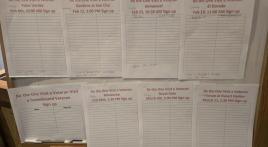
As post commander, Kurys has made Be the One a priority, working to expand training opportunities at the local level. Her goal is to train at least 100 veterans, spouses, Legion members and first responders in her community.
“These are the people who see each other regularly,” she said. “We owe it to them to know what to look for and what to do next.”
Leading by Example
Kurys believes leadership begins with honesty. She speaks openly about her own suicide attempt not to dwell on the past, but to break stigma and encourage action.
“Veterans listen to veterans,” she said. “If we don’t talk about this, we miss the chance to reach someone before it’s too late.”
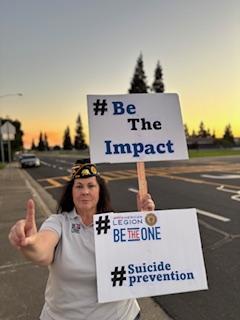
That commitment to visibility has taken Kurys beyond the post level. This year, she is using every platform available - including participation in an international pageant - to amplify the Legion’s Be the One message and reach audiences who may not yet be connected to Legion programs.
“Wherever veterans are, the message needs to be there too,” she said.
One Legionnaire Can Save a Life
For Kurys, Be the One is not a slogan - it is a call to action.
“One person noticing. One person asking. One person staying,” she said. “That’s how lives are saved.”
Her story underscores what Legionnaires across the country already know: the strength of The American Legion lies in its members’ willingness to stand watch over one another.
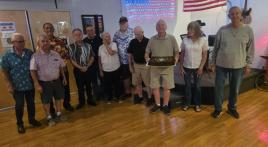
On Sept. 25, during National Suicide Prevention Month, Kurys as commander hosted Post 249's first Be the One training. This was the first of what she hopes becomes a larger community training event.
“I’m still here because someone chose to act,” Kurys said. “Now it’s my responsibility - and ours - to do the same for others.”
Legion posts interested in hosting Be the One training can find resources and materials at legion.org/betheone.