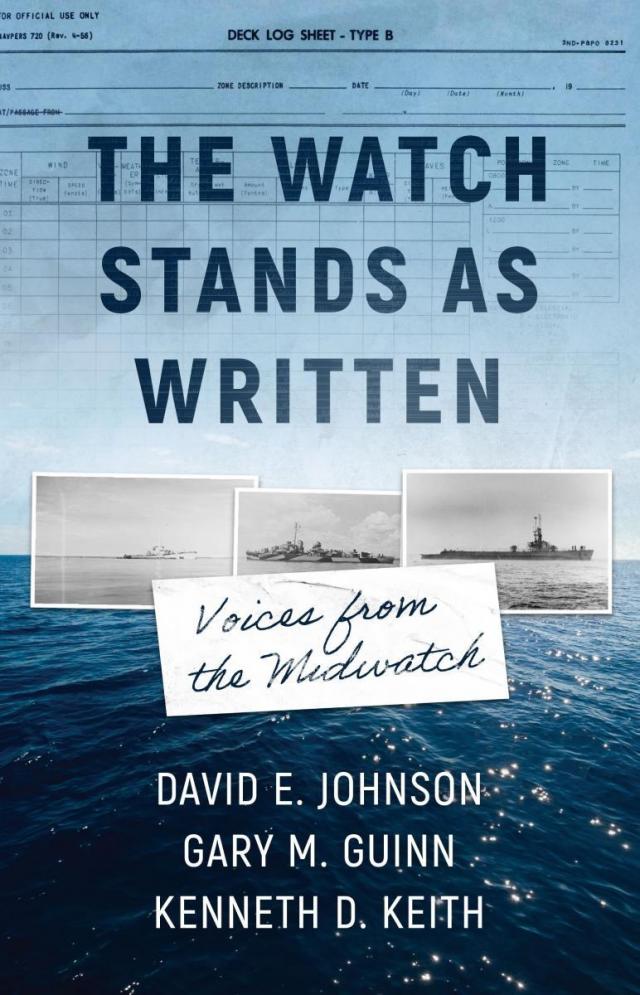
A curious and little-known Navy tradition - the writing of the first deck log of the new year on Navy ships in verse - resulted in the standard, jargon-filled, sometimes indecipherable ship log being written as a poem. The origin of the tradition is unknown, but examples go back at least a century. During the 1950s the tradition flourished, and the poems served as vehicles to express a wide variety of emotions on the part of the young officers who wrote them, revealing their humanity and their “American spirit.” While the world around them began to splinter, young sailors wrote poems not just about international issues but also about the issues that young men face everywhere.
The content of "The Watch Stands As Written: Voices from the Midwatch" came from over 10,000 deck log poems taken from over 16,000 Navy ship logs. The poems reveal the zeitgeist of the nation and the mindset of individual sailors who wrote the poems - their aspirations, their fears, their engagement with the critical events of the era. The poems included in this book span the Korean War, the Cuban Missile Crisis, the Vietnam War, the Cold War with its threat of nuclear annihilation, the space race and the cultural upheaval of the 1960s. Through the Cold War years, the dark cloud of the threat of nuclear war hung over the country. The mushroom cloud, nuclear bomb shelters, and the phrase “duck and cover” became part of the American lexicon. "The Watch Stands As Written" focuses not on the poetry itself, but on what the poems reveal about the young naval officers and the country at large. Excerpts from the poems are used to support general assertions about thematic material.
Deck log poets offered tongue-in-cheek complaints about having to write a poem; found novel topics to address, such as ship visitations and hauntings; and attempted a variety of methods to increase the appeal of their poem to the reader. Among those were the imitation of classic or popular poems, such as “Gunga Din,” “The Raven” and “The Night Before Christmas”; the use of unusual rhyming words; the creation of novel poetic structures; and art in the form of marginalia. And through it all, the poems reflected the dogged humor of the American sailor.