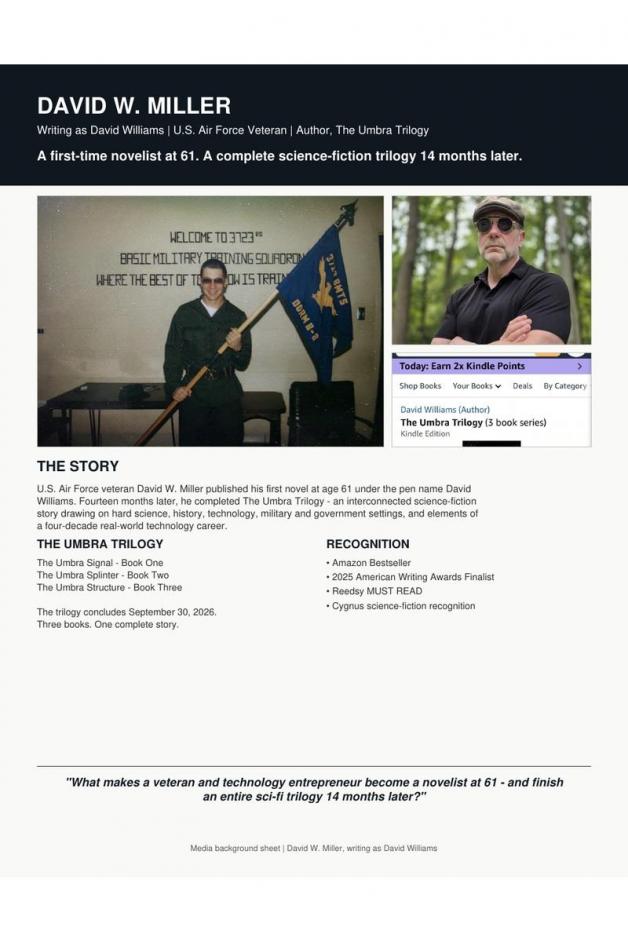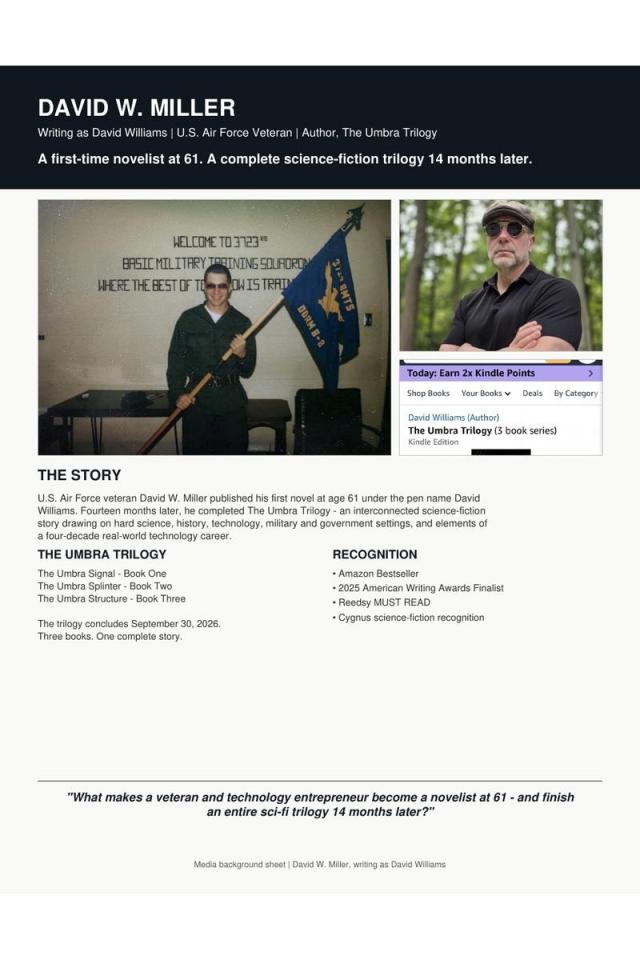
In 1982, at 18, I joined the U.S. Air Force. I certainly wasn't thinking about becoming a novelist.
The Cold War was very real. Ronald Reagan was president, the Soviet Union was on the other side of a geopolitical divide that seemed likely to define our lives, and my four years in the Air Force became the beginning of a career that eventually took me into engineering, emissions measurement, technology development and entrepreneurship.
But somewhere along the way, another idea stayed with me.
What if some of the biggest questions we ask about the universe, time, human history and our place within it were actually connected?
It took me more than four decades to finally write the story.
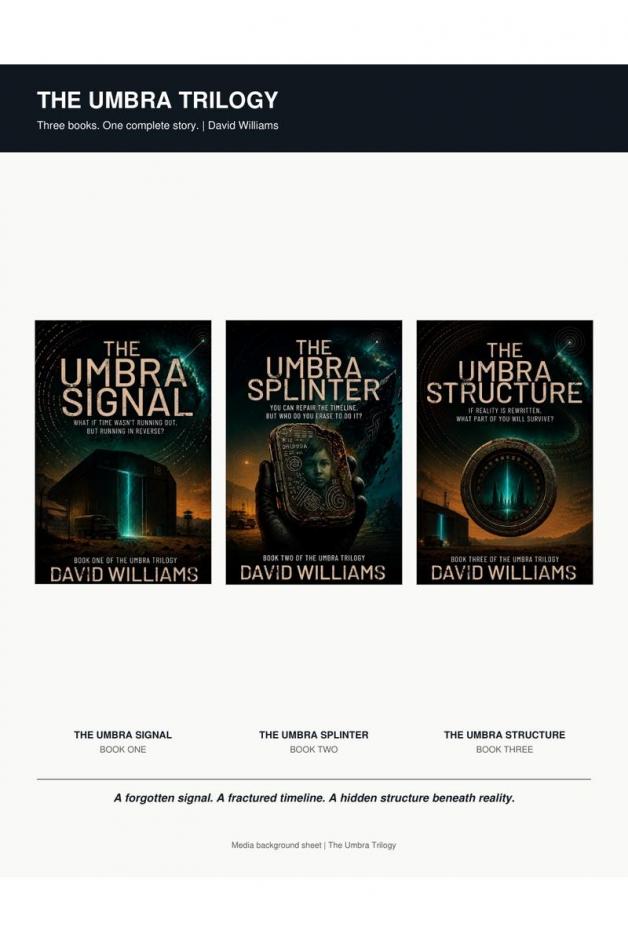
At 61, under the pen name David Williams, I published my first novel, "The Umbra Signal." What began as one science-fiction story grew into a trilogy following scientists, engineers and ordinary people confronting a discovery that challenges their understanding of time, history and reality itself.
Now, at 62, I've completed the Umbra Trilogy.
There is something fitting about beginning my adult life in uniform during the Cold War and eventually writing a story in which that era, the early space program, science, technology and questions about humanity's place in the universe all become important.
"The Umbra Signal" became an Amazon best-seller, was named a 2025 American Writing Awards finalist, received a Reedsy Discovery MUST READ designation, and was selected for the 2026 Cygnus Awards Long List. It was followed by "The Umbra Splinter" and the concluding novel, "The Umbra Structure."
Perhaps the part I most wanted to share with other veterans is this: military service becomes part of us, but it doesn't define the limits of what comes afterward. Careers change. Life takes turns we never imagined when we first put on a uniform.
Sometimes something you've carried for decades is still waiting for you.
Mine happened to become a science-fiction trilogy.